




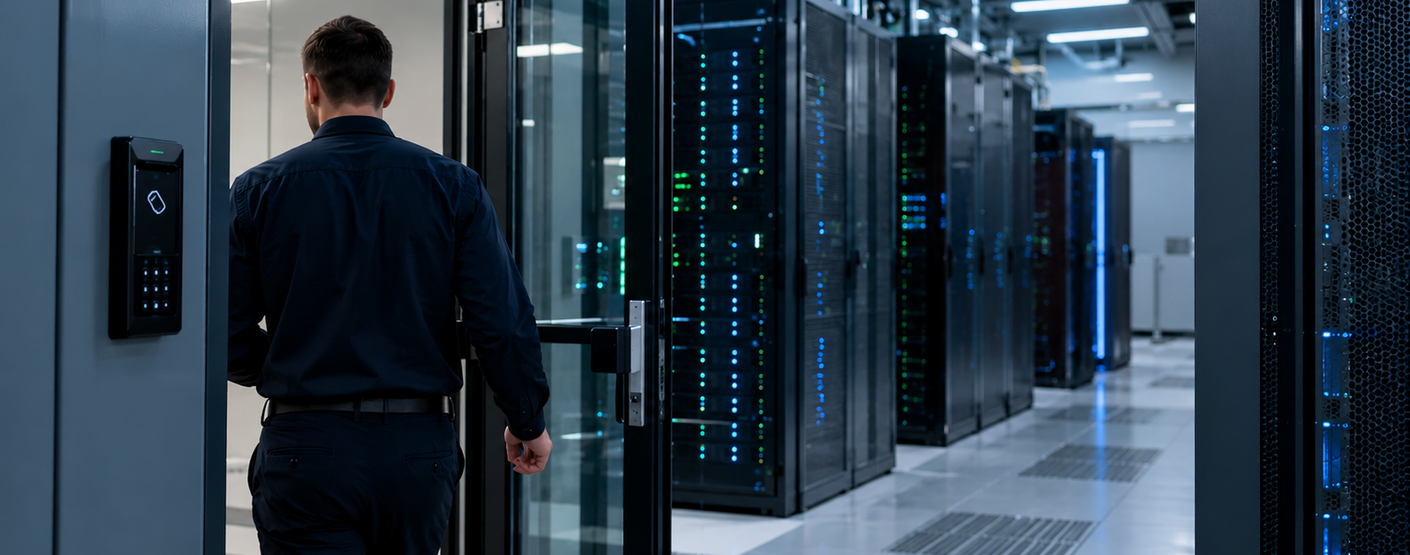
Securing data centers and server rooms: layered access, tamper detection, and audit trails
Physical access is becoming a bigger security concern for data center operators. In AFCOM’s State of the Data Center 2026, 61% of respondents ranked human threats — internal or external — among their top security risks, up fr om 40% in 2024.
For data centers and server rooms, the challenge is not simply keeping unauthorized people outside the building. Effective data center physical security requires several layers of protection between the territory and the equipment itself, combining critical infrastructure perimeter security, identity verification, access control, and continuous monitoring.
Why one access point is not enough
A server room may sit inside an office, industrial facility, university, government building, or dedicated data center. Employees, contractors, maintenance teams, and external specialists can all require different levels of access.
A single badge-controlled door therefore provides limited context. Security teams need to know whether the person using a credential is actually authorized for that specific area, whether someone followed them through the door, and what happened after access was granted.
This is why layered access control for data centers is important. Different controls can be applied as people move closer to sensitive infrastructure — fr om building entrances and controlled corridors to server rooms and other restricted technical zones.
Connecting access with video evidence
Server room video surveillance adds context to access-control events. Cameras positioned around critical entrances can help operators visually verify who entered, investigate unusual activity, and review events when access is disputed.
Facial recognition can provide an additional identity-verification layer for highly restricted areas, while video analytics can monitor predefined zones and draw attention to unauthorized presence.
Maintaining surveillance integrity is equally important. A camera that has been deliberately covered, moved, or defocused creates a gap exactly wh ere visibility may be needed most. Automated camera-tampering detection can alert operators when the surveillance view is compromised.
Together with access records and archived video, these tools create a clearer audit trail: who accessed the area, when the event occurred, and what happened around it.
How TRASSIR supports layered physical security
TRASSIR provides the technological core for integrated AI-powered security systems combining video surveillance, access control, analytics, and centralized event management.
This can form part of a broader enterprise data center security management approach, wh ere multiple security layers are monitored through a unified environment.
For data centers and server rooms, TRASSIR ACS can combine access events with video surveillance, while Face Recognition can add biometric verification for sensitive areas. Restricted-zone analytics can provide additional monitoring around technical rooms, and TRASSIR Sabotage Detector can generate alerts when cameras are blocked, lose focus, or have their viewing angle changed.
A relevant example is a government authority in Saudi Arabia responsible for collecting, analyzing, and reporting national data. After moving to a new headquarters, the organization required 24/7 monitoring, long-term video retention, protection of critical areas, and infrastructure ready for future access-control integration.
TRASSIR deployed centralized VMS, NeuroStation infrastructure, high-resolution vandal-resistant cameras, and analytics. The completed system provides monitoring across the facility and parking areas, automated vehicle access, and 90 days of continuous video retention, giving security teams a stronger foundation for incident review and operational accountability.
While the project is not a data center, it demonstrates an important principle for critical environments: access control becomes stronger when identity verification and video evidence are managed together.
From controlled entry to accountable access
Protecting a server room is not only about preventing entry. It is about ensuring that every sensitive area has the appropriate level of control, that surveillance remains reliable, and that security teams can reconstruct events when necessary.
By combining server room access control systems, biometric verification, restricted zone monitoring, CCTV, anti-tailgating measures, and tamper detection, organizations can create a more accountable approach to data center physical security.
This creates an opportunity to build layered systems that combine access control, biometric verification, intelligent video monitoring, tamper alerts, and searchable evidence — giving customers greater accountability around their most critical infrastructure.
What's New?
All NewsTry TRASSIR For Your Business
Learn more about how TRASSIR analytic modules work! Demo mode is an opportunity to see for yourself how the system works, and also check the interface and test all the functions.Success!
We will contact you as soon as possible